



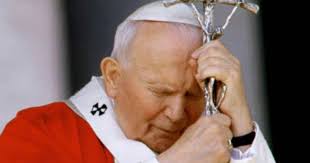
Saint John Paul II on 17 August 2002, in Poland consecrated the Divine Mercy. The consecration was celebrated by the Polish Pope after also consecrating the World Shrine of Divine Mercy in the town of Lagiewniki, on the outskirts of Krakow.
The place is very close to the convent where Saint Faustina Kowalska, the Apostle of Divine Mercy, to whom Jesus entrusted, among other things, the spreading of the Divine Mercy chaplet, passed away.
Consecration to Divine Mercy
In the homily of the Mass that he presided over that Saturday in August, John Paul II said that he was making the consecration “with the ardent desire that the message of God’s merciful love, proclaimed here through Saint Faustina, reach all the inhabitants of the earth and fill your heart with hope .”
“May the firm promise of the Lord Jesus be fulfilled: from here must come ‘ the spark that will prepare the world for his last coming,'” the pilgrim Pope then highlighted.
John Paul II also stressed that “this fire of mercy must be transmitted to the world. In the mercy of God the world will find peace, and man, happiness ”.
“I entrust this task to you, dear brothers and sisters, to the Church that is in Krakow and in Poland, and to all the devotees of divine Mercy who come from Poland and from the whole world. Be witnesses of mercy!” he encouraged.
Personal Conviction
Fr. Mauro Carlorosi, an Argentine priest of the Oratory of San Felipe Neri and a specialist in Divine Mercy, told ACI Prensa that in 2002 “the Polish Pope was urged to provide responses of Christian hope in the face of the advance of evil. Also, Divine Mercy was in some way the personal mission of John Paul II.”
Karol Wojtyla got to know the convent where Santa Faustina lived in 1938, just a few years after the nun’s death.
Being young, around 20 years old, the future Pope “worked in the stone quarry near the convent to avoid being deported. As Archbishop of Krakow he began serious and scientific work in the study of the life of the saint and her Spiritual Diary, which resulted in the initiation of the cause for the beatification and canonization of Sister Faustina”.
John Paul II beatified Sister Faustina in May 1993 and declared her a saint on April 30, 2000, making her “the first saint of the third millennium.”
On that same date, the Pope “announced that he had declared the Second Sunday of Easter as the Feast of Divine Mercy, in accordance with what the Lord had asked of Sister Faustina,” the priest highlighted.
Fr. Carlorosi also highlighted that the second encyclical of his pontificate, Dives in Misericordia ( Rich in Mercy), “was inspired by the testimony and message of the Saint.”
In Collevalenza (Italy) three years after his election, John Paul II told a crowd: “God, from the beginning of my pontificate, charged me especially with spreading his mercy.”
Sometime later he commented that at the time of his death, he would entrust himself to Divine Mercy and to the Virgin Mary.
Therefore, highlighted Fr. Carlorosi, “the consecration to the world was an act consistent with his thought and heart given to Divine Mercy as the main divine attribute, the heart of the Gospel and foundation of the message transmitted by Saint Faustina.”
Consecration Prayer
The consecration prayer, which millions of people now pray, is as follows:
God, merciful Father,
who has revealed your love in your Son Jesus Christ
and poured it out on us in the Holy Spirit, Comforter,
we entrust to you today the destiny of the world and of all men.
Bow down to us sinners;
heal our weakness;
defeat all evil; make all the inhabitants of the earth experience your mercy,
so that in You, God one and triune,
they may always find the source of hope.
Eternal Father, for the painful passion and resurrection of your Son,
have mercy on us and on the whole world.
Amen.