



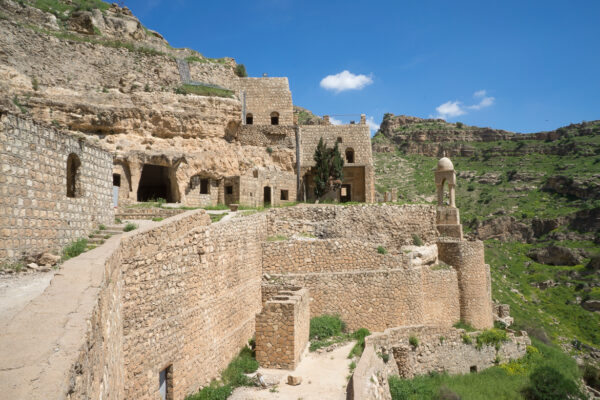
As the Islamic State terrorists set out to exterminate Christians in Iraq, they destroyed many churches and monasteries, with fine tradition, along with thousands of Christians. One among them was the oldest monastic shrine Rabban Hormizd, a monastery in the city of Alqosh, where the patriarchs of the Eastern Church of Eliya line lived. The IS invasion from 2014 to 2017 wiped out almost all Christians in the area. Although many have fled away, there are still people living in the area. Since the 10th century, the monastery of Rabban Hormizd, where patriarchs lived and were buried after their death, has been prey to several attacks. This peaceful and beautiful monastery survived the latest attack by IS terrorists. Read about Rabban Hormizd and the story of its survival.
The monastery founded by Rabban Hormizd has been named after the founder. Established in the 10th century, this monastery became a burial place for the patriarchs even before the 15th century. Only if we can understand the history of the Chaldean Catholic Church can we fully understand the history of Rabban Hormizd and its significance.
The Assyrian Church of the East is a Christian church that was born and developed in Assyria in northern Mesopotamia. That has been one of the churches that claim the heritage and tradition of the Church of the Ancient East; the official name of this church has been the Apostolic Catholic Assyrian Church of the East.
The Chaldean Catholic Church is a patriarchal church that belongs to the family of Eastern Autonomous Churches of the Catholic Church. In the 16th century (1552) it gained papal recognition in the Catholic Church following a schism in the Church of the East due to the election of a sect of Ramban named Yohannan Sulaqa as Patriarch. As he assumed the patriarchal title of ‘Shimun VIII’, his successors were also known as the Shimun line. But in 1662, this church severed ties with the Pope and became the modern Assyrian Eastern Church and remained independent. At the same time, in 1552, the Eliya line, which included the descendants of Patriarch Mar Shimun VII, who was not ready to unite with the Pope, became part of the Catholic Church in 1830 during the time of Patriarch Mar Yohann Hormizd.
Between 1551 and the 18th century, the monastery became the residence of the patriarchs of the Eliya lineage. Therefore, this monastery has the reputation of being the largest and oldest monastery of the Eastern Church before the split of Sulaqa in 1553. The tombs of 9 patriarchs who lived from 1497 to 1804 are located in Rabban Hormizd. After the attack of the Kurds in 1743, this monastery became unknown. However, in 1808 Gabriel Dambo, an Assyrian, recovered and renovated this abandoned monastery. After that a few students who had taken poverty and celibacy as a vow of life were recruited and brought there and formed into a seminary.
After Gabriel Dambo was killed by Kurdish soldiers in 1832, the Kurds attacked Rabban Hormizd in 1838 and massacred the Chaldeans. In 1843, the Christian villages of Alqosh were attacked for money and massacred the Christians. Rabban Hormiz defaced as well as subjected a country and its Christians to brutal persecution.
The Rabban Hormizd Library, rich in Syriac manuscripts, was looted and destroyed by the Kurds in 1828. It had to face the same situation in 1868. 147 volumes of manuscripts were destroyed by the Kurds during that time.
A. Wallis Budge, who visited Rabban Hormizd Monastery in 1890, describes the monastery with these words:
“Rabban Hormizd Monastery is built half about halfway up the range of mountains which encloses the plain of Mosul on the north, and stands in a sort of amphitheater, which is approached by a rocky path that leads through a narrow defile; this path has been paved by generations of monks. The church is of stone and is of a dusky red color; it is built upon an enormous rock. In the hills round about the church and buildings of the monastery are rows of caves hewn out of the solid rock, in which the stern ascetics of former generations lived and died.
They have neither doors nor any protection from the inclemency of the weather, and the chill which they strike into the visitor gives an idea of what those who lived in them must have suffered from the frosts of winter and the drifting rain. Some of them have niches hewn in their sides or backs in which the monks probably slept, but many lack even these means of comfort. The cells are separate one from the other and are reached by narrow terraces, but some of them are perched in almost inaccessible places, and, unless other means of entrance existed in former days, could only have been approached by the monks crawling down from the crest of the mountain and swinging themselves into them.
I saw no marks of fire in any of the cells. Some cells have a second small cave hewn out behind the larger one which is entered through an opening just large enough for a man of average size to crawl through. The monks eat meat on Easter Day and Christmas Day only, and their usual food consists of boiled wheat and lentils, and dark-colored, heavy bread cakes. They drink neither wine nor spirits, and they have neither light nor fire. They drink rainwater which they preserve in rock cisterns. They are called to prayer by the ringing of a bell at sunset, midnight, daybreak, and at certain times of the day. The number of monks in 1820 was about fifty; in 1843 it was thirty-nine; in 1879—80 it was sixteen, and in 1890 it was about ten.”
In 1859, Patriarch Joseph Odo decided to restore this monastery and its heritage even though it has been under destruction. So, with the financial help of the Vatican, a new monastery was established near Alkhosh, about a mile from Rabban Hormicide. The name of this new monastery is Our Lady of Seeds (Monastery of Notre Dame Semences). Although Rabban Hormizd was always first in status and importance, monks and others moved to the new location.
After the IS Terrorist Attack
The situation of the Christians in Iraq, as well as in Alqosh has not changed even though years have passed. From 2014 to 2017, thousands of people were killed and displaced due to the attacks of IS terrorists. But at present, there are some Christians here who are unable to leave their country and tradition. There are few monks and priests to plant and water their faith.
“This will remain a Christian town, I believe. We have to stay in this land,” said Brother Saad Yohanna, an Iraqi monk working at a local orphanage.
“Far fewer people live here these days – maybe 1,000 families from 3,000 a few years ago, but it remains home for them, he added.”
Even though they are a minority, the monastery of Rabban Hormizd and the city of Alqosh are a refuge for the life and worship of the remaining Christians. Christians who still remain make pilgrimages to this monastery, a symbol of survival, to deepen their faith and take solace. Although part of Baghdad, Rabban Hormizd is still unsafe as the area is under Kurdish rule. Yet Rabban Hormizd still stands as a symbol of survival as a direct testimony to a nation’s centuries-old Christian faith.