



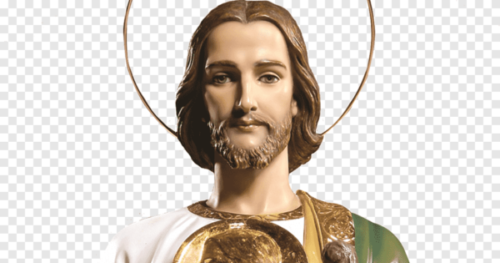
San Judas Tadeo is one of the most popular and beloved saints among Catholics due to the numerous “favors” that his devotees claim to have obtained through his intercession from him.
Here are seven facts you may not have known about the “patron saint of the impossible”:
1. Thaddeus means “magnanimous”
Tradition in the Church calls this apostle Judas Tadeo. The Evangelists Saint Matthew and Saint Mark simply name him “Tadeo” (Mt 10, 3; Mc 3, 18) and Luke calls him “Judas de Santiago” (Lk 6, 16; Acts 1, 13). Judas means “praise be to God.”
It is not known exactly where the nickname Tadeo comes from and it is considered that it comes from the Aramaic “taddà’”, which means “chest” and therefore would mean “magnanimous”. Or perhaps it arose from the abbreviation of a Greek name such as “Theodore, Theodotus”.
2. He was a cousin of Jesus
There are those who affirm that San Judas Tadeo was the brother of the Apostle Santiago, the son of Alphaeus (Cleofás), who was the brother of the just Saint Joseph. According to a document published by the Congregation for the Clergy, Cleofás married María de Cleofás, after becoming a widower from her first marriage from which San Judas Tadeo was born.
This other Mary is the “sister” of the Virgin Mary who was at the foot of the cross (Jn. 19:25). Therefore, Santiago the Less and Judas would be cousins of Jesus and nephews of Saint Joseph and the Blessed Virgin. However, it has not been possible to specify whether Maria de Cleofás was a blood “sister” of the Virgin Mary or only her sister-in-law because at that time relatives in general were called “brothers”.
3. He was very similar to Jesus
San Judas Tadeo is usually represented with a medallion on his chest that has the face of Christ. It is due to the resemblance not only physical, but also spiritual of the popular saint with Jesus.
Also, he wears a flame of fire on his head because he received the Holy Spirit at Pentecost.
Other artists show him carrying a Bible, referring to the book that bears his name. In his hand he holds an axe, which refers to his martyrdom, or a cane as a symbol of the great distances he traveled while preaching.
4. He died a martyr together with Saint Simon
Saint Jude Thaddeus preached first in Judea, then in Mesopotamia and finally in Persia. There he met with the apostle Saint Simon and together they fought the heresies of Zaroes and Arfexat, two pagan priests who raised the people against the works of the apostles.
Both received the crown of martyrdom together and that is why the Church celebrates them on the same day. His relics are found on an altar in St. Peter’s Basilica in the Vatican.
5. He had a vision of Jesus before he died
Judas Tadeo and Simón sought lodging with a disciple named Semme. The next morning some idolatrous priests and a large crowd surrounded the house and demanded that Semme hand over the apostles to them or they would burn the house. The saints gave themselves up, but they could not make them worship their idols.
Before dying, San Judas looked at San Simón and told him that he saw the Lord calling them to Him. According to ancient tradition, San Simón was killed by cutting his body in two and San Judas Tadeo had his head cut off with an ax. The Church in the West celebrates them on October 28.
6. He is patron saint of impossible causes
Saint Bridget of Sweden, mystic and patron saint of Europe, wrote that one day Jesus recommended that when she wanted to obtain certain favors, she should ask for them through Saint Judas Thaddeus. For this reason he is considered patron saint of impossible causes and shares this patronage with Saint Rita of Cascia.
7. Has an epistle in the Bible
The Epistle or Letter of Judas is part of the New Testament and is attributed to San Judas Tadeo. It was written in Greek between the years 62 and 65, before the fall of Jerusalem. It is written by a Judas, brother of Santiago, and it is not addressed to any person or Church in particular.
In it, false teachers are rebuked and an invitation is made to maintain the purity of the faith. The letter ends with a beautiful prayer (25) that says: “To the only God who is our Savior, through Jesus Christ our Lord, be glory, honor, strength and power, from before all time, now and forever. Amen”.
The Church does not endorse the controversial prayer chains
Frequently they circulate on the Internet and in papers left in homes or temples, an alleged “Chain or Miraculous Novena to San Judas Tadeo” that requires that the content be shared with a certain number of people and in a period of time to obtain blessings and threat. with ills to those who break its circulation. The origin is unknown, but the Church does not endorse these initiatives.
If you wish to consecrate yourself to San Judas Tadeo, you can do so with this prayer.